
Questions and registration flaneur.cam@pm.me
Course instructor Caio Simbula
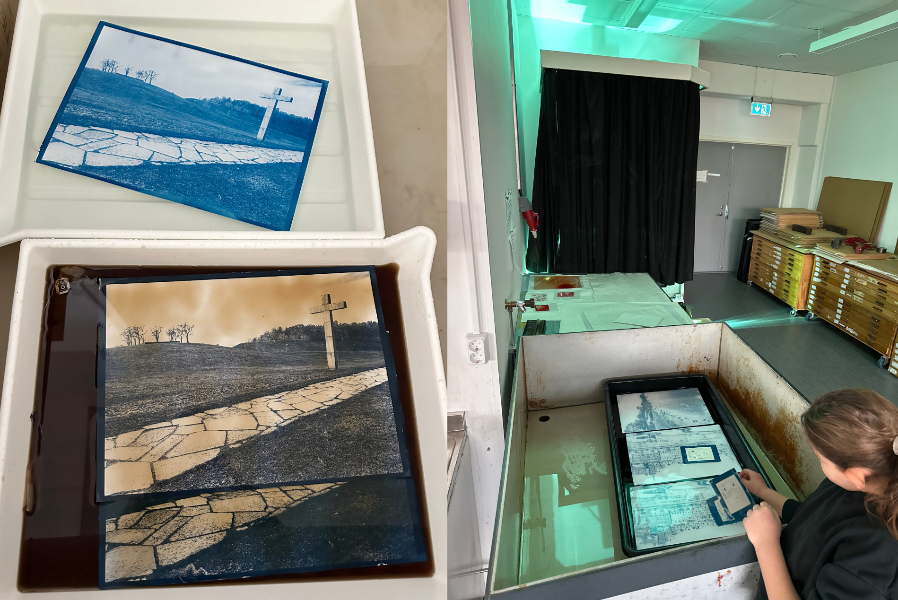
The purpose of this course is to combine digital photo technology with cyanotype printing, one of photography’s oldest printing methods developed by Sir John Herschel in 1842. The cyanotype process relies on ultraviolet light sensitive iron salts, the same chemistry used for making architectural blueprints. Often associated with “camera-less” photogram techniques, we will be creating digital negatives of the final print size for contact printing photographic images onto hand-coated cyanotype papers in the Graphic Department’s UV Vacuum Frame Exposure Unit.
When 13-14 Dec, Saturday and Sunday 10-16.
Cost Course fee 2500kr (payable via SWISH) + Workshop Rental Fees 166kr/day + 25% moms (payable to KKV via invoice) NOTE: Non-members pay double the Workshop Rental Fees
Number of Participants 3
Language The course will be held in English
Course Objective
This workshop will teach the following
1. Mixing cyanotype chemistry and coating papers (in the Analog Photo Lab)
2. Creating digital negatives (in the Printshop)
- Adjusting the image in Photoshop
- Printing the negative
3. Exposing & Developing the cyanotype print (in the Graphics Dept.)
- Using the vacuum frame and UV light source
- Developing the prints in water
- Simple toning with tannins (black tea or coffee)
Required Materials
Please bring the following items:
- A digital image to print (up to size A4) on a thumb drive or hard drive (USB-A, USB-C, Thunderbolt 3 or 4 connections)
- Papers to coat, preferably acid-free watercolor papers, but you are free to experiment.
- Note: acid-free papers will be more archival than other types of paper
- Smoother papers will reveal finer photographic details
- The max image area for this workshop will be up to size A4
Optional Materials
The following items would be helpful to you:
• Brush (with no metal parts), so that you don’t have to wait your turn for a brush
- Haké or sponge brush (available at many art supply stores)
• Plastic container (cleaned/washed ice cream or yogurt container for chemistry)
• Rubber or latex gloves to keep hands clean from chemistry
• Apron (or your art/work clothing you don’t care about getting stained)
• Clear glasses (to protect eyes in case of splash)
Hailing from San Francisco, CA, Caio Simbula has had a wide and varied career in the visual arts, having worked in the graphic arts, packaging, photography, television, film, and gaming industries. Graduating in 2018 with an MFA in Cinema, he's had work screen at Santa Cruz International Film Festival, SF Docfest, SF Noise Pop Festival, as well as broadcast on PBS, and taught filmmaking courses at San Francisco State University. Here in Stockholm, he's worked on Film and TV projects for both streaming and theatrical release, including projects that have premiered at the Cannes Film Festival. Now, he's gone full-circle and returned to the world of still images where he's exploring hybrid digital-analog printmaking methods in both traditional black and white silver-gelatin based printing as well as cyanotypes.
https://caiofilm.com/cyanotypes/
Cancellation Policy
The course fee is paid in advance one week before the course starts. If you are unable to attend, please notify the instructor as soon as possible so that someone else may take your spot. If cancellation is made later than 7 days before the course starts, the full course fee and workshop rental will be charged.